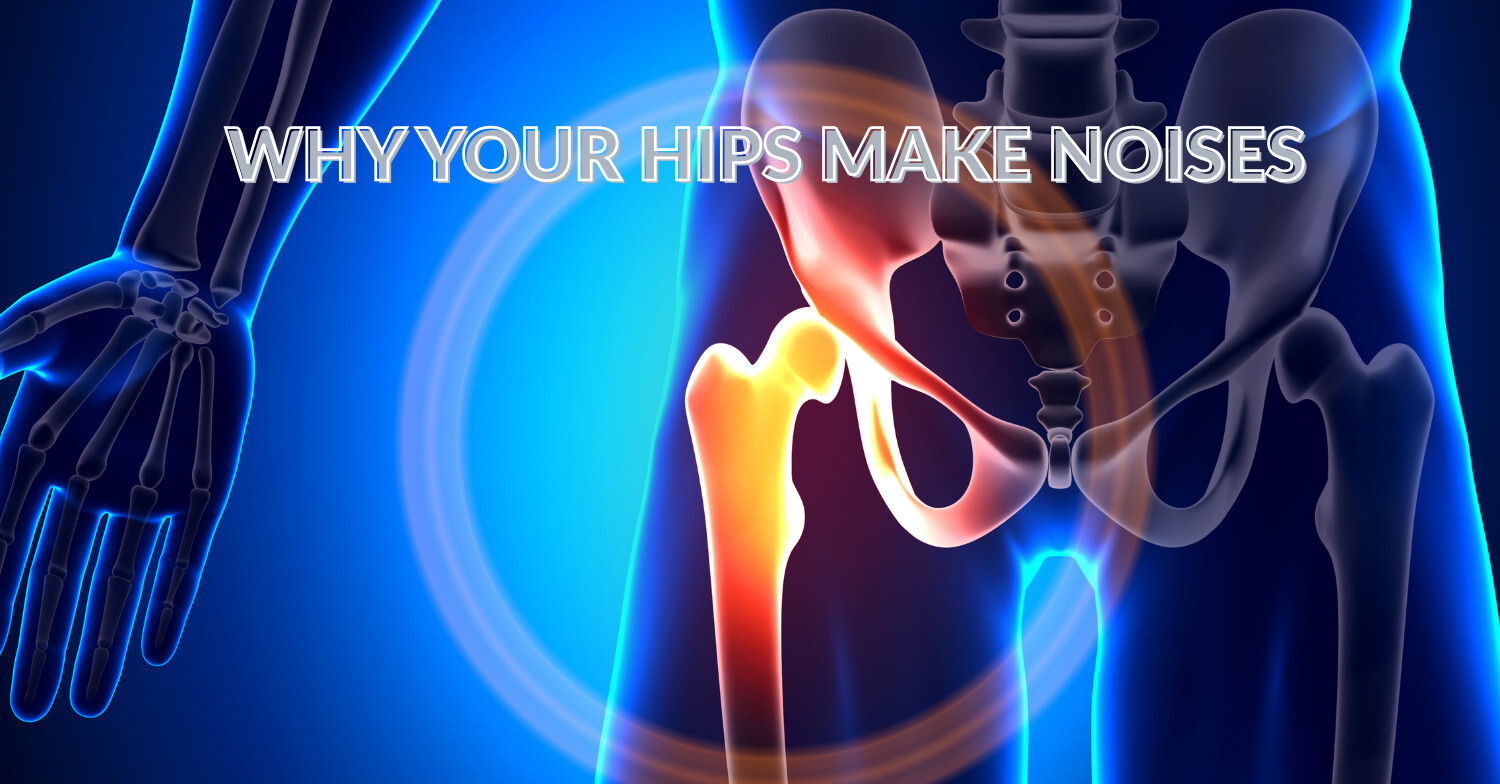
What’s Going On When Your Hips Are Making Noises? (Clicks, Pops & Snaps Explained)
If your hip clicks, pops, or snaps when you stand up, walk, or squat — you’re definitely not alone. Many hip sounds are harmless and related to tissues moving over bony structures or natural joint mechanics. In some cases, noise combined with discomfort or mechanical symptoms like catching may be worth having assessed by a healthcare professional.
This guide breaks down what may be happening, when to pay attention, and supportive strategies you can consider.
Key takeaways
• Occasional, pain-free hip noises are often normal and related to tissue movement or natural joint pressure changes.
• Some people experience snapping hip, where tendons glide over hip structures — common in active individuals.
• Noise + pain, catching, locking, or giving way may mean it’s time for an assessment by a healthcare provider.
• Strategies like modifying activity volume and supporting hip strength and mobility may be helpful for comfort, depending on individual needs.
Why hips make noise
1) Tendons gliding over bone (Snapping Hip Syndrome)
Two common patterns:
External snapping
The iliotibial band or gluteus maximus tendon moves over the outer hip (greater trochanter). This may create a visible or felt “snap.”
Internal snapping
The iliopsoas tendon moves over bony structures at the front of the hip, often noticed when rising from sitting or doing leg raises.
This type of hip noise is especially common in dancers, runners, and athletes, and is often not harmful.
Research notes that snapping hip often involves tendons gliding over bony landmarks, especially the iliopsoas and iliotibial band, and is common in active individuals such as dancers and runners. (AAOS; StatPearls)
2) Natural joint pressure changes (Cavitation)
Similar to knuckle cracking — small pressure shifts in joint fluid can create a pop. This is a common, non-painful, and often normal phenomenon.
Imaging studies show that joint “pops” are often caused by natural gas bubble formation in the joint fluid during movement, similar to knuckle cavitation. (Kawchuk et al., 2015)
3) Hip complex irritation
Areas around the hip — like gluteal tendons or bursae — may feel creaky or noisy when irritated. This may be accompanied by tenderness rather than distinct popping.
4) In some cases: intra-articular involvement
Occasionally, hip noises accompanied by groin pain, locking, or giving way may relate to deeper structures such as the labrum. If symptoms are persistent, progressive, or mechanical in nature, a medical assessment may be appropriate.
Medical literature suggests that hip noises combined with groin pain, catching, or giving-way may indicate labral involvement or other intra-articular factors and should be assessed by an appropriate healthcare provider. (Mass General Brigham; Cleveland Clinic)
When hip noises are usually normal
• No pain or lingering discomfort
• No locking, catching, or giving-way
• Happens more during the first few reps, then settles as you warm up. Many people have joints that make noise without concern.
When to consult a healthcare professional
Consider seeking assessment if you notice:
• Hip noise with pain or movement restriction
• Sensation of catching, locking, or giving-way
• Night pain or pain that limits daily activities
• History of fall or trauma with difficulty weight-bearing
If unsure, a regulated healthcare provider can help guide next steps.
Supportive strategies
These ideas are general and not a diagnosis or treatment plan. Response varies individually depending on history and presentation.
 Activity modification
Adjusting volume or intensity of activities that repeatedly provoke symptoms (such as high-knee drills or deep hip flexion) can help support comfort.
Smooth, controlled strengthening
Supporting strength and control around the hip — especially glutes and deep stabilizers — may help the hip move smoothly.
Examples include:
• Bridges and hip hinge drills
• Side-lying hip abduction variations
• Step-downs or controlled single-leg balance exercises
Gentle mobility work
Comfort-focused hip mobility work, especially around the hip flexors and lateral hip tissues, may support ease of movement.
Technique awareness
Adjusting stride length, squat depth, or movement patterns under guidance may support comfort and control.
Interprofessional care
Physiotherapists, chiropractors, and physicians may assist with assessment or management if symptoms persist.
Massage therapy can provide supportive care for comfort, relaxation, and mobility tolerance and may be part of a collaborative approach when appropriate.
FAQ
Is hip popping harmful?
Often no — especially if it’s painless and occasional.
Does hip popping mean arthritis?
Not necessarily. Noise alone doesn’t predict arthritis.
Should I stop exercising if my hip clicks?
If there’s no pain or mechanical symptoms, many people continue activity comfortably with appropriate volume and technique. If unsure, a clinician can help.
This article is for general educational purposes and not a substitute for individualized assessment. Registered Massage Therapists do not diagnose medical conditions. If you have symptoms that concern you, especially pain, locking, instability, or mobility changes, please consult an appropriate healthcare professional.
Need support maintaining comfort and mobility?
Ikonic Massage provides CMTO-licensed mobile massage therapy in:
•Brantford
•Oshawa
• Whitby
• Ajax
• Pickering
We collaborate with allied health providers when needed and focus on comfort, professionalism, and an evidence-informed approach.
 Save the drive. Enjoy the therapy.
References
American Academy of Orthopaedic Surgeons. (n.d.). Snapping hip. OrthoInfo. https://orthoinfo.aaos.org/en/diseases–conditions/snapping-hip StatPearls Publishing. (2023).
Snapping hip syndrome. In StatPearls. National Center for Biotechnology Information. https://www.ncbi.nlm.nih.gov/books/NBK556013/ Kawchuk, J. W., Fryer, J., Jaremko, J. L., Zeng, H., Rowe, L., & Thompson, R. (2015).
Real-time visualization of joint cavitation. PLOS ONE, 10(4), e0119470. https://doi.org/10.1371/journal.pone.0119470 Full Text: https://journals.plos.org/plosone/article?id=10.1371/journal.pone.0119470
Mass General Brigham. (n.d.). Hip labral tear. https://www.massgeneralbrigham.org/en/patient-care/services-and-specialties/sports-medicine/conditions/labral-tear Cleveland Clinic. (2021).
Hip labral tear. https://my.clevelandclinic.org/health/diseases/22139-hip-labral-tear
Mark Ikonomu
Contact Me